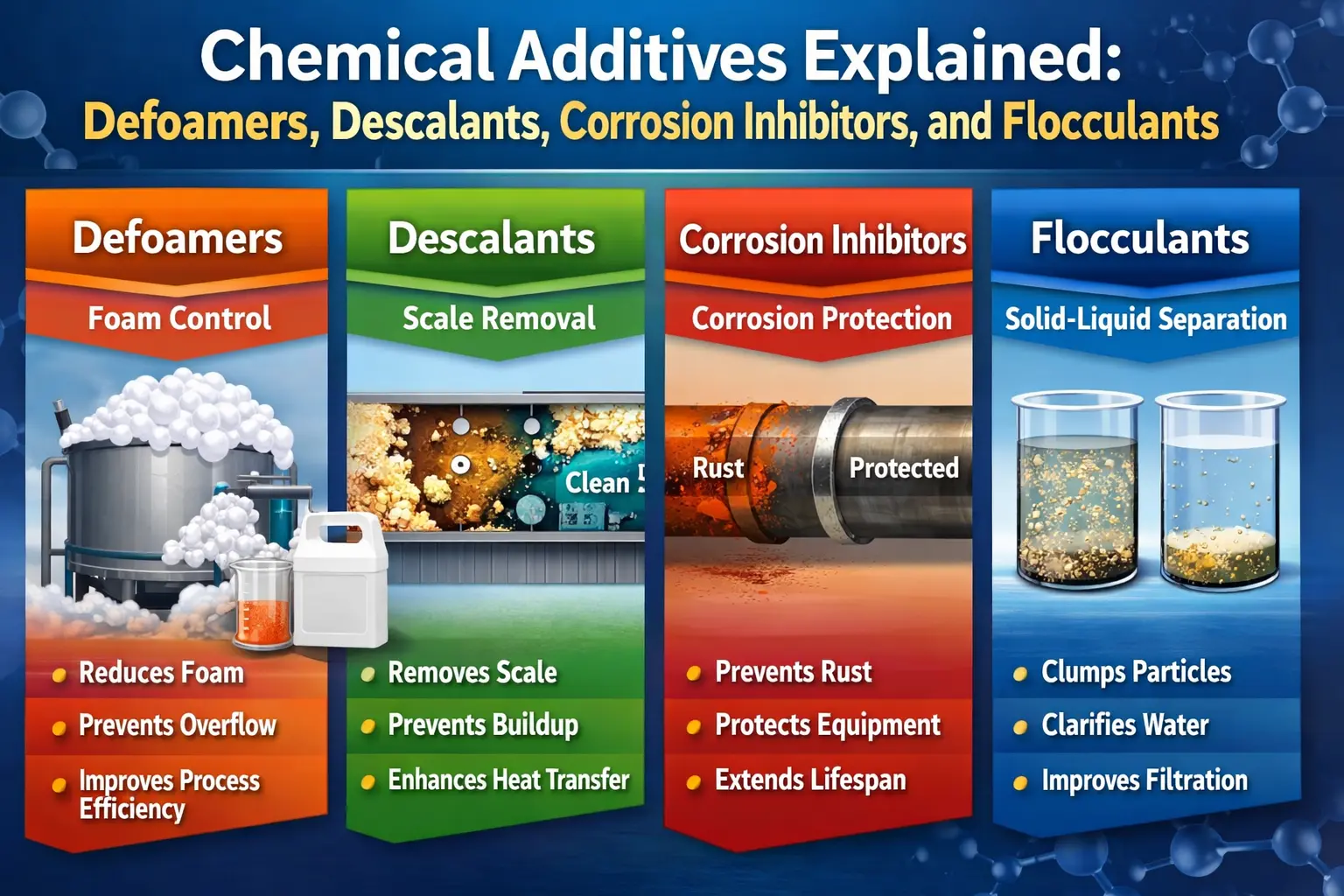
Chemical Additives Explained: Defoamers, Descalants, Corrosion Inhibitors, and Flocculants
In industrial operations, even small process issues can lead to major losses if left unchecked. Problems such as excessive foaming, scale buildup, corrosion, or poor wastewater clarification directly affect productivity, equipment life, and operating costs. This is where chemical additives become essential. Though used in controlled quantities, they play a powerful role in keeping industrial systems stable, efficient, and reliable.
This article explains the importance of key industrial chemical additives—defoamers, descalants, corrosion inhibitors, and flocculants—and how they support smooth operations across industries such as water treatment, sugar, distillery, boilers, cooling systems, and effluent treatment plants.
Understanding Chemical Additives in Industry
Chemical additives are specialized formulations designed to solve specific operational challenges. Unlike bulk process chemicals, additives work by modifying system behavior—preventing unwanted reactions, improving separation, or protecting equipment surfaces.
They are widely used in:
Industrial water treatment systems
Boilers and cooling towers
RO and DM plants
Sugar and distillery processes
Effluent and wastewater treatment plants
Selecting the right additive ensures better process control, lower maintenance costs, and improved compliance with environmental norms.
Defoamers: Managing Foam for Process Stability
What Do Defoamers Do?
Defoamers, also called antifoaming agents, are used to control excessive foam formation in industrial processes. Foam can reduce tank capacity, interfere with sensors, cause overflow, and disrupt treatment efficiency.
Descalants: Protecting Systems from Scale Formation
What Is Scaling?
Scaling occurs when dissolved minerals like calcium and magnesium deposit on surfaces, forming hard layers. This reduces heat transfer, blocks flow paths, and damages membranes and equipment.
Role of Descalants
Descalants are chemical additives that prevent scale formation by keeping minerals in a dissolved state. They are especially important in systems where water quality varies.
Where Descalants Are Used
Reverse Osmosis (RO) plants
Boilers and heat exchangers
Cooling water systems
Industrial water treatment units
Key Benefits
Prevents membrane fouling
Improves energy efficiency
Extends equipment lifespan
Reduces frequency of chemical cleaning
Effective descalant dosing ensures consistent performance and lowers operating costs.
Corrosion Inhibitors: Extending Equipment Life
What Causes Corrosion?
Corrosion occurs when metal surfaces react with water, oxygen, or chemicals, leading to material degradation. Over time, this can cause leaks, system failure, and unplanned shutdowns.
How Corrosion Inhibitors Work
Corrosion inhibitors form a protective layer on metal surfaces, reducing chemical reactions that cause rust and metal loss.
Typical Applications
Boilers and cooling towers
Pipelines and storage tanks
Heat exchangers
Closed and open water circulation systems
Advantages of Using Corrosion Inhibitors
Protects costly equipment
Reduces repair and replacement costs
Improves system safety
Enhances operational reliability
A well-managed corrosion control program is critical for long-term plant performance.
Flocculants: Improving Water and Effluent Treatment
What Are Flocculants?
Flocculants are additives that help fine suspended particles bind together to form larger, heavier clusters called flocs. These flocs settle faster and are easier to remove from water.
Applications of Flocculants
Effluent Treatment Plants (ETPs)
Sewage Treatment Plants (STPs)
Water clarification systems
Sludge thickening and dewatering
Benefits of Flocculants
Faster settling and improved clarity
Better filtration efficiency
Reduced sludge volume
Improved compliance with discharge standards
Flocculants are essential for efficient solid–liquid separation in water and wastewater treatment.
Why Chemical Additives Are Essential for Industry
Using the correct combination of defoamers, descalants, corrosion inhibitors, and flocculants helps industries:
Improve operational efficiency
Minimize equipment damage
Reduce downtime and maintenance
Optimize energy and chemical usage
Meet environmental and safety regulations
Chemical additives are not optional extras—they are critical components of modern industrial systems.
Choosing the Right Chemical Additive Solution
The effectiveness of a chemical additive depends on:
Process conditions
Water chemistry
Equipment materials
Industry-specific requirements
Proper selection, testing, and technical support ensure consistent results and long-term benefits.
Conclusion
Chemical additives such as defoamers, descalants, corrosion inhibitors, and flocculants play a vital role in keeping industrial processes efficient, safe, and cost-effective. When used correctly, they protect equipment, improve system performance, and support sustainable operations.
At Gurupharma chemical industries, we provide reliable, high-quality industrial chemical additives tailored to the needs of diverse industries. Our solutions are designed to deliver performance you can trust—day after day.
👉 Explore our chemical additive solutions and experience how the right chemistry makes a real difference.
Ms. Deepali serves as the CEO of Guruchem Enterprises, a leading Maharashtra-based company specializing in industrial and specialty chemicals. She also leads Gurupharma Chemical Industries, a manufacturing firm focused on producing high-performance specialty chemicals widely used in the sugar and ethanol industries.
Serving diverse sectors including sugar mills, distilleries, power plants, and allied industries, Guruchem Enterprises is known for providing high-performance, sustainable chemical solutions. Driven by a strong focus on research, innovation, and quality, the company remains dedicated to addressing the evolving needs of its clients. Ms. Deepali oversees accounts, audit, and administration, while also playing a key role in strategic growth and operational excellence.
Arjun Kawade
CEO – Guruchem Technologies
Arjun is a CEO of Guruchem Technologies, is a highly accomplished Chemical Engineer and Environmental Specialist with more than 25 years of extensive experience in the industry.
Arjun, established the company with a mission to enhance and modernize scientific infrastructure across India. Under his leadership, Guruchem Technologies has become a trusted name in supplying laboratory apparatus, instruments, furniture, and equipment to colleges, industries, and educational institutions. The company also specializes in delivering high-quality laboratory chemicals to research and academic laboratories.